
Extended Project Qualification (EPQ)
Exam Board: OCR
Here at Rugby High School Sixth Form, we offer all Year 12 students studying 3 A levels the chance to complete an EPQ. The course runs for approximately 12 months from October of Year 12, after a launch assembly where students can register their interest. This is an independent project where students are guided through the process by a project supervisor. The focus of the course is on the development of a set of skills, including time management, research, referencing, writing, evaluating and presenting. Students attend 3 lessons per week, incorporating taught elements, progress reviews and independent working time.
The EPQ is a free choice project, meaning students choose their own theme/topic to base their work around. The only stipulation being that it must not be a topic that they are studying in one of their A level subjects (although it can be an extension beyond the specification content). Alongside charting their progress in a series of documents, the culmination of the project is to produce either a non-artefact (5000 word maximum dissertation) or an artefact (a product plus a 1000 word minimum report), and to deliver a presentation to an audience. Students then compile their work into a portfolio of evidence ready for assessment at the end of the course.
Students are able to gain an insight into the way they work, and develop skills and strategies that are transferable to both their other A level subjects, as well as their next steps.
Many students chose to share project information in their UCAS applications. The EPQ is a single component that is internally assessed and externally moderated. The qualification is worth up to 28 UCAS points. There are many HE institutions who recommend the qualification and see the value it brings to students’ education.
At RHS, the EPQ aligns closely with our vision; inspiring curiosity and a love for learning, encouraging students to be ambitious and learn to apply and adapt their knowledge, to show compassion and empathy and become independent global citizens.
View the subject specification
Assessment
Assessment is based predominantly on the process as well as the outcome; from decision-making about your choice and design of your project through planning and development, to presentation to an audience, reflection and critical evaluation of its success.
You will be assessed on four areas:
- managing a project
- using resources
- developing and realising a project
- reviewing the project.
What Universities say
“The skills students develop through the Extended Project are directly relevant to and useful for university-level students. Students can refer to the Extended Project in their UCAS personal statement and at interview to demonstrate some of the qualities that universities are looking for.”
University of Manchester
“We recognise the value, effort and enthusiasm applicants make in the Extended Project. Individual academic schools will decide whether they will be using the Extended Project in their offer making and we encourage you to provide further information on your project in your personal statement. In some cases admissions tutors may wish to make an alternative offer to applicants, one of which involves successful completion of the Extended Project.”
University of Leeds
What our students say
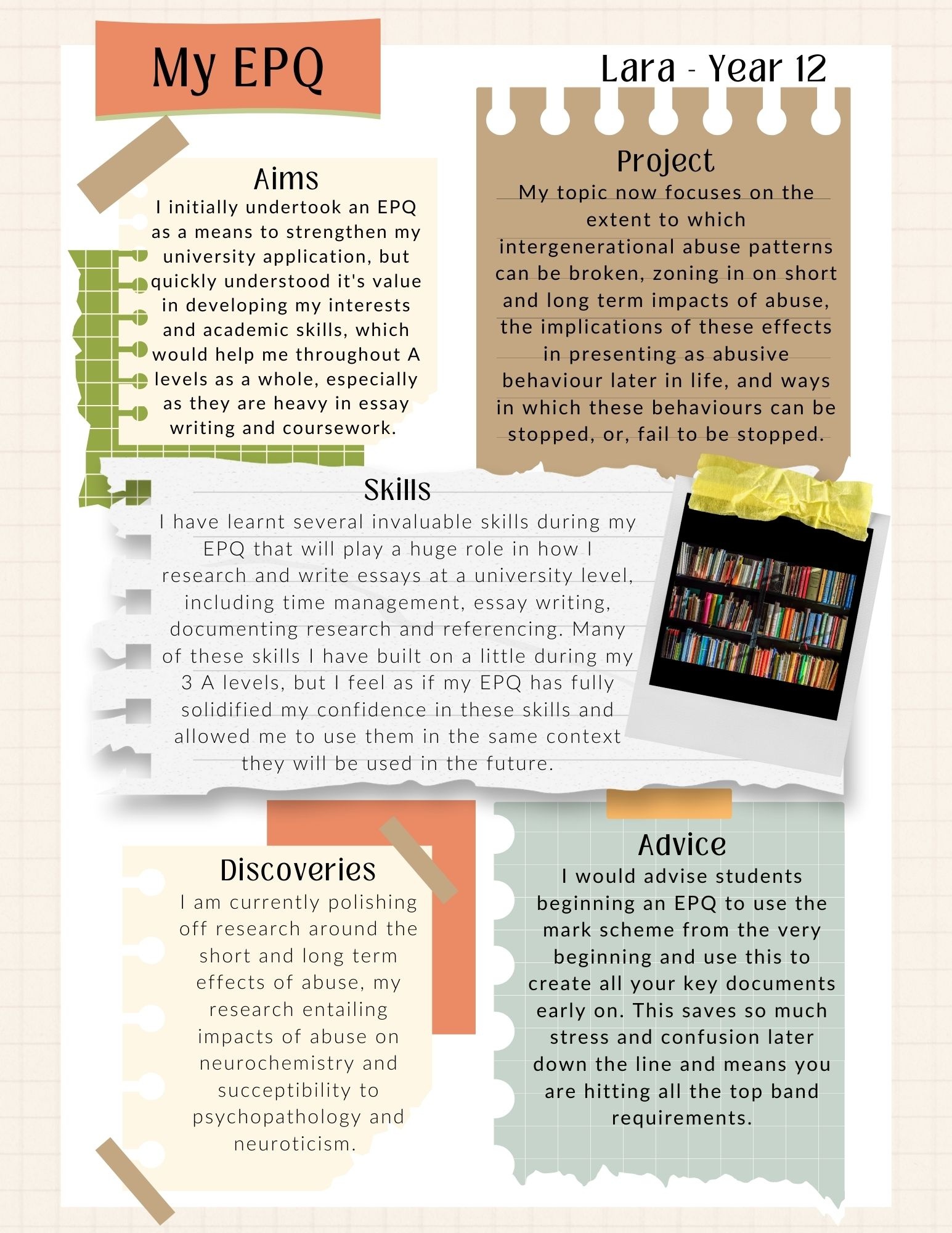
"I would advise future students to choose a topic they are genuinely interested in as this makes the research process more engaging and manageable as an EPQ is a valuable experience because it develops important academic skills and builds independence. I have found the EPQ to be a very positive experience as it has helped me grow in confidence and has improved both my academic and organisational skills."
Magda
"I chose to do an EPQ because I wanted to explore a topic that genuinely interests me beyond my A‑Level subjects. It also seemed like a great way to show universities that I can manage independent research and work on something long‑term. It will also highlight my writing skills."
Kalea
"The EPQ has helped me develop my independent research, source evaluation, organisation and time-management skills. I have become more confident at analysing different perspectives and building arguments using evidence. These skills have also supported my A Level subjects, particularly Politics and English Literature, where evaluation and critical thinking are important as well as overall confidence in presenting."
Harriet
Contact: Miss R. Holland, Head of EPQ, r.holland@rugbyhighschool.co.uk